



Setting the Standard for 2026: Taizhou Changlong's Sustainable Fishing Vessel Revolution
-
 2026-07-01
 -
 80
80
How a Zhejiang-based private shipyard is rewriting the rules for commercial fishing in an era of fuel pressure, emission caps, and traceable seafood

Source: Wikimedia Commons — Open-license reference photograph. Modern commercial fishing boats are increasingly designed as floating production platforms rather than simple catch vessels.
The commercial fishing industry is entering a period in which vessel design can no longer be judged only by power, deck space, or range. Operators must balance fuel costs, stricter environmental rules, crew safety, seafood traceability, and the economics of working farther from port. In that context, Taizhou Changlong Shipbuilding Industry Co., Ltd., a private shipyard in Zhejiang with roots going back to the 1990s, has presented its 2026 sustainable fishing vessel concept as more than a technical upgrade. It is a response to a market that is asking shipyards to help fishing companies become cleaner, more efficient, and more reliable at the same time.
Hull efficiency before any new technology
The central idea behind the new design is that sustainability begins with the hull. The shipyard highlights the use of optimized hydrodynamic forms, including finer entry lines, improved stern runs, and speed-specific hull geometry. For fishing vessels, this matters because a large share of operating cost is tied directly to resistance through the water. A hull that needs less power to maintain service speed can reduce daily fuel burn, extend range, and give owners more flexibility when fuel prices swing. Computational analysis is used to model drag and refine the vessel form before construction, allowing efficiency gains to be built into the steel rather than treated as an afterthought.
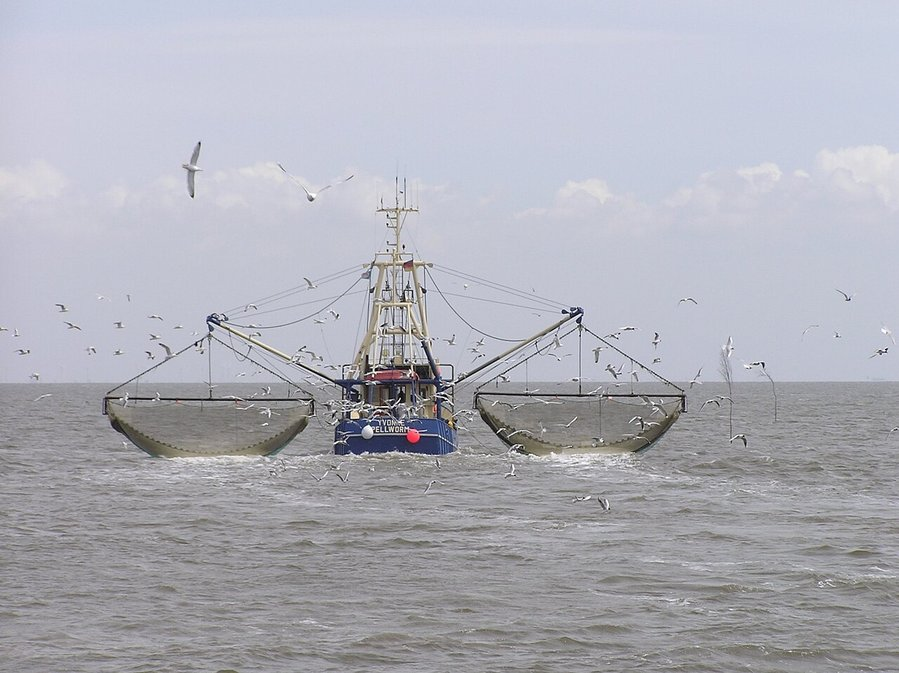
Source: Wikimedia Commons. Hull optimization through CFD can reduce power requirements by 10 to 20 percent compared with traditional designs at the same speed — a meaningful margin when fuel is the largest variable cost at sea.
Hybrid propulsion matched to a fishing voyage
Propulsion is the second major pillar. Instead of relying only on conventional diesel power, the concept combines efficient diesel engines, electric motors, and marine battery systems. Hybrid arrangements are especially relevant for fishing vessels because their power demand changes throughout a voyage. A boat may need higher output while steaming to fishing grounds, lower output while working gear, and quiet, low-emission capability while entering port. By matching power generation to each phase of operation, hybrid systems can reduce unnecessary engine load, cut emissions, and improve onboard comfort. Battery support also offers resilience when vessels need stable power for refrigeration, processing equipment, or crew welfare systems.
From fishing boat to floating production platform
The design also reflects a shift in how shipowners think about onboard equipment. Modern fishing vessels are increasingly floating production platforms, not only boats that catch fish. Efficient winches, automated baiting, refrigerated sea-water tanks, electrical deck machinery, and digital catch-handling systems all demand reliable power and ergonomic layout. The Changlong concept integrates these systems with the propulsion package so that energy use is coordinated rather than split across unrelated subsystems. This approach improves safety, reduces crew workload, and supports the documentation that major seafood buyers now require for traceability.
Compliance without compromise on economics
Environmental performance is another reason the concept may attract attention from fleet operators. International and regional authorities are tightening expectations around emissions, fuel quality, and underwater noise. The International Maritime Organization continues to extend carbon-intensity rules across more vessel categories, and regional regulators in the European Union and North America have added restrictions on sulphur output, nitrogen oxides, and even acoustic impact on marine mammals. Hybrid propulsion, optimized hulls, and onboard energy management help vessels stay ahead of those rules without forcing owners to retire assets early. For owners who operate in multiple jurisdictions, a single platform that meets several regulatory regimes at once is a strategic advantage as much as a compliance cost.
A regional builder stepping into value-added design
Changlong's positioning is also rooted in its regional manufacturing base. Located in Wenling, on the coast of Zhejiang, the company has developed from a private shipbuilding team into a builder with decades of practical experience across fishing boats, cargo ships, and special-purpose vessels. The fishing vessel concept is therefore not an isolated product line; it sits inside a wider engineering culture that has spent years solving the same problems for other ship types — corrosion control, fuel efficiency, classification society approval, and on-time delivery. The broader significance of the announcement is that Chinese private shipyards are moving further into specialized, value-added vessel design. Rather than competing only on basic construction capacity, they are offering integrated solutions that connect naval architecture, digital modeling, and lifecycle economics.
Why the 2026 concept matters for owners
If the concept performs as described, its strongest contribution may be the way it connects environmental responsibility with operational economics. Cleaner vessels are often discussed as a regulatory burden, but in practice they usually lower fuel consumption, reduce maintenance on engines and fuel systems, and open access to premium seafood markets that demand verifiably sustainable sourcing. For a vessel owner weighing a newbuild order, that combination is what turns sustainability from a slogan into a balance-sheet decision. The Taizhou Changlong 2026 concept suggests that the shipyards competing in this space will increasingly be judged not only by steel quality but also by their ability to model, simulate, and deliver a vessel that is cleaner from hull to wheelhouse.
— Industry Analysis, sourced from tzclcy.com/news (2026)


关注微信公众号
