



Beyond the Quote: A Shipowner's Due-Diligence Guide to Choosing a Chinese Private Shipyard
-
 2026-09-07
 -
 57
57
The lowest number in a newbuild tender is rarely the cheapest ship. Owners who have lived through a difficult build know that the figure which decides the outcome is the one nobody prints on the first page: the probability that the vessel arrives on time, to rule, and without a claims file that outlives the warranty.
A serious due-diligence visit to a Chinese private yard takes one or two days. Taizhou Changlong Shipbuilding Industry Co., Ltd., a private builder in Songmen Town, Wenling City, receives owners, charterers and class representatives on exactly that basis, and the questions experienced buyers ask are remarkably consistent. They fall into a handful of recurring groups.
Start with the order book, not the brochure
The first useful question is what is on the floor right now, for whom, and to which class. A yard building a repeat series for an established owner has already had its drawings, procedures and work packages tested by that owner's site team. A yard building one-off designs for first-time clients offers variety but fewer proven repetitions, and repetition is where consistency comes from.
Ask directly about delivery record. Contractual dates and actual dates are the two numbers that matter, and a yard willing to show both is signalling confidence. Reference calls to previous owners are worth more than any presentation; the most informative answers usually concern how problems were handled rather than whether problems occurred at all.
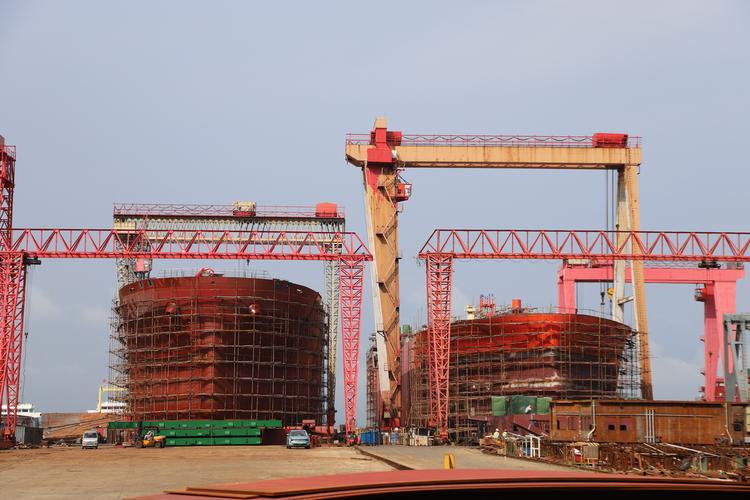
Source: Wikimedia Commons (CC BY-SA 3.0). China's private yard landscape is broad; the difference between bidders shows up in process discipline, not in brochures.
Read the production system, not the presentation
Boardroom capability is easy to describe. Shop-floor capability is not. Look at how steel moves: is there a covered stockyard, are plates tagged at intake, is there crane coverage over the main assembly lines, and do blocks flow in a logical sequence or wait for space? Automated welding cells with sensor feedback and machine vision improve consistency on long seams, but they only pay where the surrounding logistics keep the cell fed.
Look at housekeeping as well. Clean shop floors, labelled materials, tidy cable runs during outfitting and orderly control of weld consumables correlate strongly with rework rates and, ultimately, with the number of findings a class surveyor will raise during sea trials. None of these things is expensive; all of them are habitual.
Ask how quality evidence is stored
Quality in shipbuilding is not a claim, it is a record. Weld procedure specifications, welder qualification records, material certificates, non-destructive testing results and dimensional survey data must exist, be retrievable, and be tied to a specific plate and a specific joint. Ask to see a recent package for a completed block and follow one joint from intake to sign-off.
Modern yards increasingly hold this in a single digital environment that a classification society can review before visiting, which compresses approval cycles and reduces late disputes. Digital radiography, phased-array ultrasonic testing and three-dimensional laser scanning are the standard markers of that capability, and a yard's ability to pull them up on screen during a visit is itself a test of how well its data is organised.
Check the people behind the schedule
Schedules are kept by teams, not by plans. Ask who the project manager will be, whether that person stays with the project from contract to delivery, and how engineering changes are processed. Ask what proportion of the design work is done in-house. A yard that controls its own hull form development, structural analysis and outfitting design can absorb a late owner request without waiting on an external design house.
Workforce stability deserves equal weight. Retention among welders, fitters and electricians is a leading indicator of build quality across a series, and retention is rarely an accident. Yards that invest in training, safety and welfare tend to show lower turnover, and lower turnover shows up as fewer weld repairs and steadier progress through block erection.
What happens after delivery
The relationship does not end at the signing hall. Warranty response, spare-parts coordination, technical support during the first dry-docking and assistance with class renewal all affect the true cost of owning the vessel. Ask for the escalation path and, preferably, for the names of the people who have actually handled a post-delivery claim.
There is a second reason to test this early. As the fleet ages and emission rules tighten, the same yard may be the one asked to perform a retrofit in five years. A builder that supports its own newbuildings through their service life is also building the knowledge base that makes that retrofit shorter and cheaper.
Watch how the yard handles change
No build of consequence finishes without changes. Owner requests, maker delays, rule amendments and simple discoveries on the floor all force the plan to move. What separates a manageable project from a painful one is the mechanism: a documented engineering change process, a single owner-side point of contact empowered to decide, and a yard that prices and schedules variations transparently rather than absorbing them silently and recovering the cost later.
Ask to see a recent variation log. It is among the most honest documents a yard can share. It reveals how quickly technical questions were answered, whether cost and schedule impacts were stated up front, and how much of the final contract sum was added after signing.
Finally, walk the quay. Vessels alongside being commissioned, blocks at different stages of outfitting and a trials team preparing for sea acceptance tell an experienced visitor more about a yard's maturity than any certificate on the wall. A yard that is busy with the right kind of work is usually busy because previous owners came back.
Quick Reference
• Order book: current hulls under construction, client references, class societies, contract versus actual delivery dates.
• Production system: plate tagging and traceability, crane coverage, automated welding, block flow, housekeeping standards.
• Quality evidence: WPS and welder qualifications on file, digital radiography, phased-array UT, 3D laser scanning, retrievable per-joint records.
• People: named project manager, in-house design capability, workforce retention.
• Change management: documented variation process, single decision-maker on the owner side, transparent pricing and schedule impact.
• After-sales: warranty escalation path, spare-parts support, class-renewal and retrofit capability.
• Commercial: milestone-linked payment terms, unambiguous specification, transparent variation pricing.
— Industry Analysis, prepared for Taizhou Changlong Shipbuilding, 2026.


关注微信公众号
